


Lord Ganesha is one of the most loved and widely worshipped deities in Hinduism. Being the god of wisdom, the deity of new beginnings, and the remover of obstacles, he is worshipped before any event, ritual, travel, and venture for a smooth end.
Most of us have knowledge of why Ganesha was born, why he has an elephant head, and more. But very few of us have knowledge of the significance behind these stories. Why is Lord Ganesha first worshipped? What is the story behind Lord Ganesha’s elephant head and his mouse vehicle, and why is he so fond of modaks? In this complete guide, we will explore and find all the answers to these questions.
The Untold Story Behind the Ganesha Elephant Head
One of the most fascinating stories about Lord Ganesha tells us how he was born and how did he get the elephant head. According to Hindu mythology, Goddess Parvati wanted privacy while she bathed, so she created a boy with turmeric paste, breathed life into him, and asked him to guard her doorway and let no one pass. After some time, Lord Shiva returned and tried to enter, but the small boy stopped him as directed by his mother. Shiva did not know this child was his own son, and Ganesha was also not aware that Shiva was his father.
A fierce moment followed. In anger, Shiva cut off Ganesha’s head. When Mata Parvati emerged and saw the tragedy, her grief was profound, and her fury was unmatched. To console her, Lord Shiva sent his ganas to find the head of the first creature they came across, sleeping with its head facing north.
The Ganas found the first creature sleeping with its head facing north, which was an elephant. The head was brought to Lord Shiva, placed on the boy’s body, and life was restored. From that moment, that boy was named Ganesha, the son of Lord Shiva and Mata Parvati.
But What Does the Elephant Head Truly Represent?
The elephant is considered the biggest and the wisest of all animals. It has an extraordinary memory, incredible problem-solving intelligence, and deep emotional awareness. An elephant is powerful, yet gentle. It can clear a forest path, but it moves with awareness. That is exactly why Ganesha is called the remover of obstacles.
His large head teaches us to think big, his small eyes remind us to focus, and his ears tell us to listen more. His curved trunk shows the ability to handle both big and small tasks with grace.
The Hidden Meaning of His Broken Tusk
The broken tusk of Lord Ganesha is one of the most powerful symbols. Many people see it as a visual detail, but it has a much deeper message.
According to the Puranas, the most popular story is that the sage Vyasa asked Ganesha to write the Mahabharata as he dictated it. Bhagwan Ganesha agreed, but there was one condition: Sage Vyasa must recite it without stopping. Sage Vyasa agreed, but added a condition for Ganesh ji: he had to understand every verse before writing it.
As the writing progressed, Ganesha's feather quill broke. Rather than interrupting the work, he broke off one of his tusks and used it as a pen to write the Mahabharata. The broken tusk represents the ability to let go of perfection for the higher purpose. It teaches that wisdom often requires sacrifice.
This is why Lord Ganesha is worshipped by students, writers, business owners, and more who are seeking knowledge. He is not only the god of the beginning, but he is also considered the god of intelligent actions.
The Secret Significance of His Four Sacred Hands
The traditional depictions of Ganesha feature four hands. Each hand symbolises something important.
His first hand wields an axe to sever the bonds of ego and attachment. His second hand holds a rope to pull devotees toward wisdom. The third hand cradles a modak, representing the sweet rewards of spiritual effort, while his fourth hand is raised in a blessing of protection and peace.
For this reason, a Ganesh idol does not simply serve a decorative purpose. It serves as a constant reminder of the need to remove the obstacles, stay true to wisdom, experience the joy of devotional practice, and walk along the path under the protective auspices of blessings.
Why Ganesha Is Always Worshipped First
One of the most common questions we come across is why do we worship Ganesha before any other god?
Lord Ganesha is worshipped first in Hindu rituals because he is Vighnaharta, the remover of obstacles, and the patron of new beginnings. Invoking his name before a wedding, business venture, or journey ensures the psychological and spiritual removal of hurdles, paving the way for smooth progress.
A very famous incident comes to mind in relation to the story of Ganesha and his brother Kartikeya. According to this story, Lord Shiva and Mata Parvati asked their sons to go around the world, and the one who makes a complete circuit of the world first would win the race. So Kartikeya immediately sped away on his Vahana (vehicle) which was a peacock. Knowing he could not match his brother's speed on a tiny mouse, Ganesha chose a different path. Instead of racing across the globe, he simply walked around his parents, declaring that they were his entire world.
This is often known as the Ganesha wisdom story and shows that not every wise step needs to be quick. It further shows that knowledge is independent of speed. It is hence, that Ganesha is worshipped before any god not just because he removes all the obstacles, but because Ganesha teaches the best way to start a new beginning.
The Mystery of Ganesha and The Moon Curse
Here is a story that many people have never heard, and yet it is one of the most fascinating in all of Ganesha's mythology.
Once upon a time, after celebrating a grand meal in honour of his birthday, Ganesha decided to ride his mouse home. However, his mount stumbled after seeing a snake on the road, causing Ganesha to fall to the ground. As a result, his belly got torn open, and all the modaks he had consumed spilled onto the floor.
Unfazed, Ganesha calmly gathered the spilt sweets, tucked them back into his belly, and used the snake as a makeshift belt to secure them.
The full moon in the sky watched this with amusement and openly mocked Ganesha for being so fat that even falling could not hurt him. He laughed at his belly bursting open, at his mouse, and at his overall ridiculousness.
However, Ganesha was not amused by this mockery. So he told the moon that whoever looked at the moon during the festival of Ganesh Chaturthi would be falsely accused of a crime.
As a result, the prideful full moon started to wane.
This mythological story teaches us several things. First of all, it shows us that mocking others is bad, as well as laughing at their misfortunes. And secondly, it says that pride, even the pride of something as beautiful as the moon, leads to downfall.
Even today, devout Ganesha worshippers avoid looking at the moon on Ganesh Chaturthi. The tradition lives on not just as superstition but as a reminder of the story and its lesson.
There is also a redemption, the moon eventually appealed to Ganesha and begged forgiveness. Ganesha softened the curse that the moon would not disappear entirely, but would wax and wane as a permanent lesson in humility.
The Lesser-Known Forms and Avatars of Ganesha
Everyone is familiar with the statue of Lord Ganesha, sitting calmly with a smile on his face. However, in Hindu mythology, there are many other forms of Ganapati.
There are 108 names of Ganesha, each reflecting a special attribute associated with him. Some of the famous names of Ganesha include:
- Ganapati: The lord of the groups or divine forces
- Vinayaka: Supreme guide
- Vighneshvara: The lord of obstacles
- Lambodara: The one who has a large belly
- Ekadanta: Only has one tusk
- Gajanana: Elephant-headed
- Sumukha: Auspicious-faced
- Siddhivinayaka: Grantor of successes
Apart from these, Bhagwan Ganesha also has various forms reflecting strength, wisdom, prosperity, protection, and enlightenment.
How to Choose a Ganesha Idol With Meaning
The importance of a sacred idol increases if it resonates with you and your intentions. For worshipping at home, check out a serene Lord Ganesha idol for home.
As a gift, a stylish Ganesha idol would serve well on house-warming occasions, weddings, and other celebrations.
To bless your journey, Haritual also offers elegant options like the black Ganesha idol for car and Antarmukhi Ganesha idol for car, ideal for those who prefer a small, meaningful idol with a clean look.
The Surprising Role of Ganesha in Other Religions
Many people find it rather surprising to know that Ganesha worship takes place even beyond India’s geographical boundaries.
The worship of Ganesha can be observed even in Nepal, Sri Lanka, Thailand, Indonesia, Cambodia, Japan, and other parts of Southeast Asia. He has an identity in various cultures and spiritual practices, mostly associated with wisdom, protection, wealth, and obstacle removal.
Ganesha is also present in Buddhism, specifically certain schools of Tantric Buddhism. In some places, he is known as the guardian deity, while in others, he is considered the god of wealth.
It proves the far-reaching nature of symbolism associated with Ganesha. While his origins lie deeply rooted in Hindu dharma, Ganesha's message is universal: to begin every journey with wisdom, conquer internal obstacles, and walk through life with humility.
A Short Note on Ganesh Chaturthi
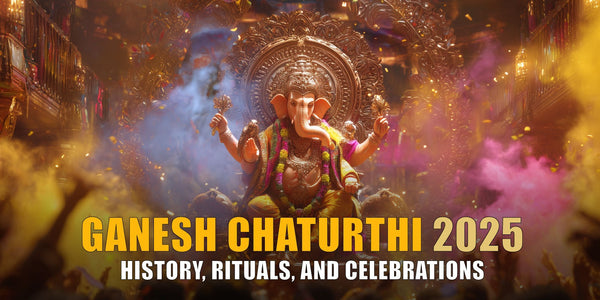
Ganesh Chaturthi is an Indian 10-day festival dedicated to the birthday of Lord Ganesha. It usually occurs between August and September, in Bhadrapada month, specifically on the Chaturthi day, which coincides with the waxing moon.
Freedom fighter Bal Gangadhar Tilak transformed the festival into a grand public event in 1893. Before this date, Ganesh Chaturthi was mostly celebrated privately in the family environment.
During the 10-day celebration period, the Lord Ganesha idol is placed at home and outside at various pandals in a decorated form. On the next day (or the last day in the case of private observation), the idol is ceremonially taken for immersion in a water body. This is referred to as Ganesh Visarjan.
Visarjan ceremony has great meaning as Ganesha, who was born from the earth (in fact, he was created from Parvati's body from clay or turmeric), goes back to the earth via the water. This reminds us that “Nothing is permanent”. It serves as a poignant reminder that even the divine takes form and departs, teaching us the ultimate lesson of detachment and impermanence.
Bring Ganesha’s Blessings Into Your Space
Whether you are preparing for Ganesh Chaturthi, decorating your home temple, choosing a meaningful gift, or looking for a peaceful idol for your work desk, you can explore Haritual thoughtfully crafted collection of Ganesha idols, god idols, and selected car dashboard idols for smooth and fearless journeys.
For compact and elegant options, you can also explore a Ganesha idol, Ganpati idol for car, or a meditating Ganesha idol for a calm and sacred presence.
Conclusion
Lord Ganesha is much more than a familiar festival deity or a beautiful idol placed at the entrance of a home. He is a symbol of wisdom, humility, fresh starts, success, and inner strength.
When we ask, "Who is Lord Ganesha?" the question can't be confined to just the mythologies. He is a spiritual prompt that every impediment has a lesson to offer, every start demands clear intention, and every success demands a humility that does not breed an ounce of ego.
Whether you call him Ganapati, Ganesh, Vinayaka, or Vighnaharta, his message is constant: be a thinker, doer, listener, non-egoist, and move forward in faith.
Frequently Asked Questions
Ques 1: Why is modak Ganesha’s favourite?
Ans 1: Modak is considered Ganesha’s favourite sweet because it symbolizes the sweetness of wisdom, devotion, and spiritual effort.
Ques 2: Is Ganesha worshipped in other countries?
Ans 2: Ganesha is worshipped and respected outside India, including in Nepal, Sri Lanka, Thailand, Indonesia, Cambodia, Japan, and other regions influenced by Hindu and Buddhist traditions.
Ques 3: What is the significance of Ganesha’s mouse?
Ans 3: The mouse represents the ego and desire that is always nibbling, always restless. Ganesha riding the mouse is a symbol of mastery over the ego, not its destruction. It teaches that wisdom is not about suppressing the mind, but about directing it.
Ques 4: What is Ganesha’s favourite colour?
Ans 4: Lord Ganesha’s favourite colour is believed to be red. Red symbolises auspiciousness, energy, prosperity, and devotion, which is why red flowers, sindoor, and red cloth are often used in Ganesh pujan.
Ques 5: Which Ganesha idol is good for the home entrance?
Ans 5: A peaceful and blessing form Ganesha idol is commonly preferred for the home entrance. Many devotees choose a seated Ganesha idol that symbolises protection, positivity, wisdom, and prosperity.